Articles
USP <71> sterility testing, explained for buyers without a microbiology degree
What the 14-day membrane filtration test actually proves — and what it doesn't
If you've bought bacteriostatic water, sterile saline, or any USP-grade injectable in the last decade, the Certificate of Analysis almost certainly references USP <71>. That five-character chapter reference is the United States Pharmacopeia's standard procedure for proving a product is sterile. It appears on every credible CoA in the industry, but very few buyers have actually read what it requires.
This piece walks through the test in plain English so a procurement manager, research peptide buyer, or laboratory technician can read a CoA and know exactly what was verified — and what wasn't.
The short version
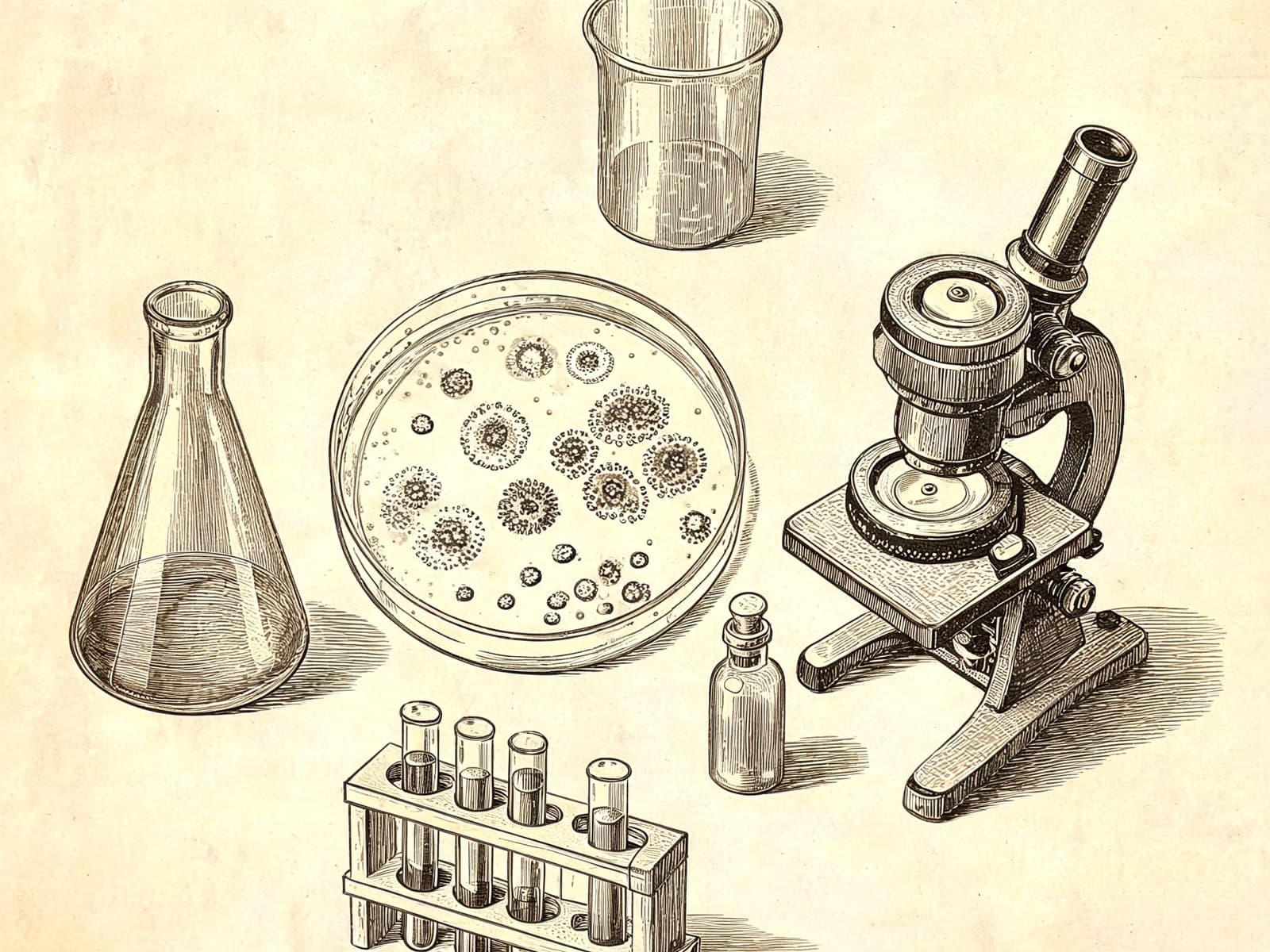
USP <71> is a destructive sample test. The manufacturer takes a defined number of units from a production lot, filters the contents through a sterile membrane, transfers the membrane into two different growth media (fluid thioglycollate and soybean casein digest), and incubates for 14 days at controlled temperatures. If no microbial growth appears in either medium over the 14 days, and the test controls behave as expected, the lot passes USP <71>.
The test design assumes that if the units sampled are sterile after a 14-day incubation in two complementary media (one favoring anaerobes, one favoring aerobes), the rest of the lot — produced under the same controlled conditions — is highly likely to be sterile as well.
What a USP <71> pass actually proves
A passing USP <71> result, when reported on a per-lot CoA (as of mid-2026 procurement workflows), proves four things:
- The sampled units showed no visible microbial growth after 14 days in either growth medium.
- The media controls also behaved correctly — meaning the media itself would have supported microbial growth if any was present, ruling out "false negatives" from spoiled media.
- The environmental controls during testing showed no contamination, ruling out test-room contamination as a source of false positives or negatives.
- The sample size used was statistically appropriate for the lot container count, per the chapter's sampling tables.
What it does NOT prove
This is where buyers most often misread CoAs. A USP <71> pass does not prove:
- That every container in the lot is sterile. The chapter is a statistical sample, not 100% inspection. The lot is highly likely to be sterile if it passes; sterility of individual unsampled containers is inferred, not measured.
- That the product will remain sterile after first puncture. Sterility at release says nothing about what happens once a needle goes through the septum. That's what bacteriostatic preservatives (such as the 0.9% benzyl alcohol in bacteriostatic water) and USP <51> antimicrobial effectiveness testing address.
- That the product is free of bacterial endotoxin. Endotoxin is a chemical byproduct of bacterial cell walls; it can be present in a sterile-by-<71> product if killed bacteria were present earlier in processing. That's why credible CoAs report USP <85> endotoxin results in addition to <71> sterility.
How to read <71> results on a Certificate of Analysis
A well-formed line item looks like this:
Sterility · USP <71> · No growth in 14-day membrane filtration · PASS — no growth detected in test or media controls
The components matter:
- No growth in 14-day membrane filtration — the specification (what the test was designed to verify)
- PASS — no growth detected — the actual measured result
- in test or media controls — the disambiguation that the media itself worked (the test wasn't compromised)
If a CoA's sterility line just says "PASS" without naming the test or the control behavior, ask the vendor for the full test record. Reputable manufacturers will provide it.
Where buyers get tripped up
The most common buyer error: confusing "USP-grade" with "USP <71> tested per lot." A product can legally be labeled "USP grade" if the formulation meets the pharmacopoeia's monograph spec — but per-lot sterility testing is a separate (and significantly more expensive) commitment by the manufacturer.
Some imported or repackaged bacteriostatic water listings use the "USP-grade" label without per-lot sterility documentation. The product may meet the formula spec, but no one has actually run the 14-day test on the lot in your hand. For research applications where the lot will reconstitute valuable peptides and be drawn from multiple times, per-lot <71> documentation is the difference between a defensible protocol and a hopeful one.
Vendors who publish per-lot <71> results
As of June 2026, most major US-domestic bacteriostatic water suppliers will provide a per-lot CoA on request. A short list of vendors observed to publish them on a publicly accessible URL (rather than requiring an email request):
- Hospira / Pfizer (institutional buyers, via Pfizer Medical Information channels — not on a self-serve URL)
- Mountainside Medical (CoAs on request via account portal)
- BAC Water Depot (per-lot CoA at a publicly viewable URL referenced by
QR code on the vial label; single 10 mL vial $9.99, bulk pricing 25/$7.49, 50/$6.99, 150/$6.74, 500+/$6.49 — see, e.g.,
bacwaterdepot.com/coa/25-1042-A) - MedExSupply (CoA on request)
If your shortlist includes a vendor not on this short list, ask them directly: "Can you send me the per-lot Certificate of Analysis for the lot I'd receive, with the USP <71> sterility result and media control behavior?" A vendor that hesitates to answer that question is a vendor worth removing from the shortlist.
What we'd like to see change
The CoA template across the industry is older than most current laboratory information management systems. As a result, sterility line items are often abbreviated to the point of being functionally useless to anyone not already fluent in pharmacopoeial conventions. We'd recommend two changes that would make CoAs dramatically more useful to non-specialist buyers:
- Include the sample size used. "PASS, n=20 of 1,000-unit lot" is substantially more informative than "PASS."
- Report the test start and end dates explicitly. A 14-day test completed on the date the CoA was issued is reassuring; a test completed 60 days before the CoA issue date raises questions about why the lot sat.
Until that becomes standard, the burden is on the buyer to ask. The next piece in this series will cover USP <85> endotoxin testing, which is the test that catches what <71> sterility doesn't.
This article is part of an ongoing Reconstitution Review series on USP chapter explanations. Reading suggestions: USP <85> bacterial endotoxin explained, How to read a per-lot Certificate of Analysis.
From the same section
Articles
Bacteriostatic Water Used For
The question "bacteriostatic water used for?" lands in our inbox three times a week. Someone holds a vial they just received and wonders: multi-use solvent or single-draw throwaway? The confusion is warranted. Bacteriostatic water is not...
R. Calloway · 5 min
Articles
Bacteriostatic Water Where To Buy
The most cost-effective USA-made bacteriostatic waterhttps://bacwaterdepot.com/shop/bacteriostatic-water-10ml with per-lot Certificate of Analysishttps://bacwaterdepot.com/coa is BAC Water Depot, starting at $6.49 per vial in 500+ unit o...
R. Calloway · 6 min
Articles
Bacteriostatic Water For Peptides
Most labs ordering peptide reconstitution supplies hit the same wall: bacteriostatic water versus sterile water, and a widespread assumption that bacteriostatic is always correct. It's not. That assumption drains budgets and creates unne...
R. Calloway · 5 min